
Ridgeland City Directory Holdings
No official catalog lists a complete Ridgeland-only city-directory run. The strongest nearby lead is the University of Southern Mississippi guide to Canton Polk volumes. That listing matters. The volumes offer several ways to chase a name or an address. Still, a Canton title does not guarantee that every Ridgeland street appears inside it. Read the city coverage statement in the individual volume first. Only then record a negative search or draw any conclusion about a household.
| Collection | Years | Where held | Access |
|---|---|---|---|
| Canton Polk city directories | 1963, 1964, 1966, 1968, 1970, 1972, 1974, 1976 | USM Special Collections guide | Consult the listed collection and verify Ridgeland coverage volume by volume. |
| MCLS local-history collection | Early and mid-1800s to present, dates vary by item | Madison County Library System, with many physical items at Canton or Flora | Digital discovery, staff-assisted local-history access, and collection rules apply. |
| MCLS Digital Library | Dates vary by collection | Madison County Digital Library partnership | Search digitized family and photograph collections online. |
| MDAH Madison County records | 1828-1857 and 1874-1911 series listed | Mississippi Department of Archives and History | Catalog, reading room, originals, or self-service microfilm as the series requires. |
The USM city-directories guide names the Canton years and the directory formats available. The MCLS local-history policy describes a much broader community collection. That collection includes newspapers, maps, and family histories. It also holds diaries, marriage material, military records, photographs, and oral interviews. These become companion sources when a dated directory line is missing.
Note: Record the title, edition year, page, and printed coverage statement with every directory result so another researcher can repeat the check.
Canton Directory Volumes Near Ridgeland
The USM guide lays out four useful routes through a volume. Alphabetical names come first. Entries there may list a telephone, address, occupation, and marital-status notation. A numerical street or avenue guide can turn an address into a dated householder clue. A reverse telephone section helps only in one case. It works when a number survives in a letter, clipping, or family record. Business buyer's-guide and classified pages round out the set. Those pages can explain a name tied to a store or organization. They do not prove a personal address.
- Alphabetical section
- A name-ordered part of a volume that may pair a person with a printed address, telephone, or descriptive field.
- Numerical street guide
- An address-ordered part of a directory, useful for reading nearby entries from the same edition.
- Reverse telephone directory
- A number-ordered section that can point back to a printed address clue when the number is already known.
Test the surname and its spelling variants in the alphabetical section first. Then check the numerical guide for the street number and the entries beside it. Keep the directory year visible in your notes throughout. The Library of Congress notes that city directories were published irregularly. So a missing edition does not mean a person left the area. Its directory guide is another catalog path. It is not proof that it holds a particular Ridgeland volume.
Reading a Ridgeland City Directory Line
A directory entry is a dated publication record, nothing more. It may show a printed name, address, telephone, occupation, or a marital-status notation. The details depend on the volume. It does not by itself prove ownership, a move-in date, or current presence. Preserve the entry exactly as printed, abbreviations and page reference included. If an unfamiliar mark appears, copy the volume's abbreviation key before assigning it any meaning. No householder convention or ownership symbol should be assumed without that key. Treat any unverified mark as an open question.
| Directory title and year | Identifies the specific edition and the date window represented. |
|---|---|
| Coverage statement | Shows whether the volume says it includes the place or streets being researched. |
| Name as printed | Preserves initials, suffixes, spelling, and other details needed for a later comparison. |
| Address or telephone | Provides a dated contact or location clue, if the edition printed one. |
| Occupation or descriptive field | May distinguish similar names, but remains a directory field rather than proof of identity. |
| Page and catalog identifier | Lets another reader return to the same page or catalog record. |
For modern address-keyed records, rely on county tools rather than stretching an old directory entry past its date. The Ridgeland Street Directory follows the current street, parcel, and recorded-instrument route.
Ridgeland Directory Coverage Gaps
The central limitation is plain. No official catalog entry lists a Ridgeland-specific Polk run or a precise local coverage range. Keep that gap visible in your notes. A searcher can establish an exact year and address. Then test a nearby Canton volume. The missing interval can be bridged with county tax rolls, deeds, newspaper material, census images, family papers, and local-history collections. A hit in a Canton volume may be a useful lead. A miss may simply reflect the volume's coverage. It may also reflect the date, a spelling difference, or an unlisted household.
Older place labels also matter. Ridgeland was incorporated as a village in 1899. It became a town in 1947. It became a city in 1975. Earlier material may use a different geographic description for the same broader area. The Ridgeland history map supplies dated boundary and growth context. MDAH and county records can supply the older record layer. Never silently rewrite an older place name into a current one.
Ridgeland Directory Family Files
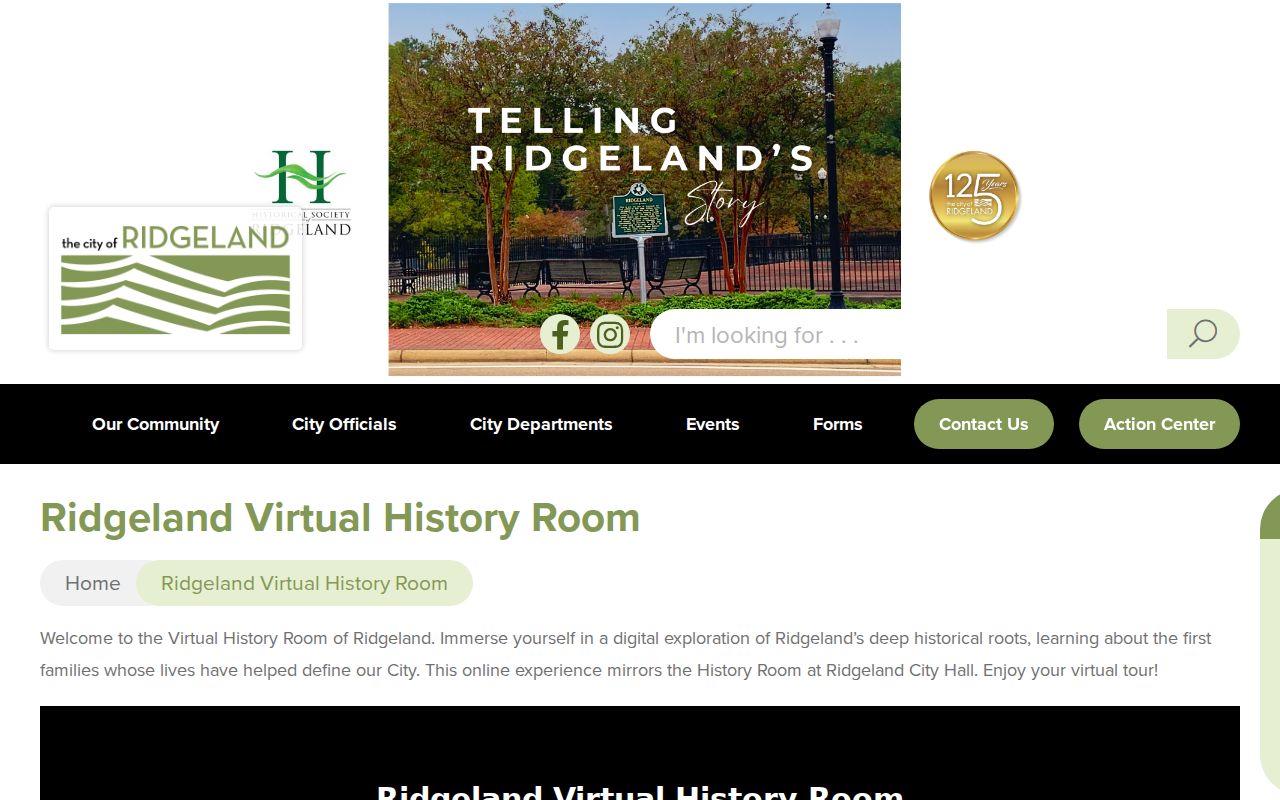
Ridgeland's Virtual History Room is an unusually rich local context source. Its exhibit list includes first-family materials, family albums, plats, photographs, maps, town documents, an 1848 Yellowley bill of sale, the 1822 and 1825 Choctaw District plats, a 1955 aerial photograph, the 1918 Town Hall, and the 1901-1954 Mayor's Docket. These materials do not replace a city directory. They can explain the family, place, or date around a directory lead and point to another record worth checking.
The official Virtual History Room is shown in this source image.
Use an exhibit citation, map date, or photograph caption as a separate piece of evidence, then corroborate it with a directory, census, deed, newspaper, or official city document. The city also invites people to share stories, but a contributed account remains different from an archival verification.
The MCLS digital-resources page opens the library's newspaper and Mississippi research routes, and the MCLS Digital Library is the direct online path for its digitized Madison County collections. Before traveling, call the Ridgeland branch at 601-856-4536 to ask whether an item is local or is held at Canton or Flora. Public computers, copying, scanning, fax service, and a digital lab are documented MCLS access channels. Canton also has an oral-history sound booth for recording family accounts.
The MCLS digital-resources screen is included here as an access reference.
Physical local-history material at MCLS lives in closed stacks. Handling is staff-supervised, pencil-only, and requires photo identification. Because staff make the copies, a phone call with a specific item request beats assuming every catalog reference is waiting at the Ridgeland branch.
Ridgeland Directory Research Eras
Directory research shifts as Ridgeland itself changes. Before incorporation, land, tax, railroad, church, family, and newspaper records often outperform a city directory. For the early village and town eras, deeds, maps, and city-formation documents can pin down the place. The Virtual History Room helps with the date. Mid-century work blends several record types. Census images, nearby directories, aerial photographs, municipal dockets, and planning maps all fit that period. Later years are different. Assessor and GIS records carry stronger current indexing. Older authoritative items may still sit in paper, microfilm, or a reading room.
| 1820s-1850s | Test MDAH land and tax records with Choctaw District plats. |
|---|---|
| Railroad and early-village period | Use deeds, maps, newspapers, formation documents, and city historical exhibits. |
| Mid-century | Compare census, the listed Canton volumes, aerial photographs, municipal material, and local collections. |
| Post-1975 expansion | Use current parcel and municipal records while retaining historic directories and maps for earlier snapshots. |
Note: A current database can point to a later record, but it never substitutes for the date and wording of an earlier printed or archival source.
Ridgeland MDAH Routes Beyond a Directory
The Mississippi Department of Archives and History is the archival fallback when a directory lead outruns the locally listed Ridgeland volumes. Its catalog needs no account to search. Circulating material does require a checkout account. Quick-search paths cover microfilm, genealogical files, a biographical index, cemetery indexes by county, and newspaper holdings. The MDAH genealogical-files search supports surname or keyword queries.
Access is not limited to a web result. MDAH research rooms are free at 200 North Street in Jackson. Most material is not online. Ready-reference help waits at 601-576-6876 or refdesk@mdah.ms.gov. Reading-room service, self-service microfilm where offered, and the image-copy order process round out the options. The MDAH research page lists a $3 mail or server handling charge for image-copy orders. The Madison County finding aid distinguishes original from microfilm access for each listed county record.
Tracing Ridgeland Directory Families
A family trail holds up best when it advances one dated source at a time. Start with a name variant and a year. A family paper, deed, photograph, census image, or news item should support both. Then try the directory access point for that year. Capture every detail if a line appears. Record the address, telephone, descriptive field, edition, and page. Pairing the entry with a record from a different office or institution keeps a directory convention from masquerading as proof of title, present residence, or identity.
- Set a date window and write down the name exactly as it appears in the starting record, including initials and spelling variants.
- Test the relevant alphabetical section, then the numerical street guide or reverse telephone section when an address or number is known.
- Record the printed coverage statement, directory title, year, page, and every address or telephone clue without modernizing it.
- Compare the directory clue with the same-era federal census, newspaper material, family file, deed, map, or official city document.
- When a line disappears, test a move, a spelling change, an unlisted household, or a coverage gap before reaching a conclusion.
The National Archives 1950 census search for Madison County is one dated household source. It pairs cleanly with a directory entry. Each record carries its own date and collection method. A careful result states which source supplied the address and which one corroborated the family connection.